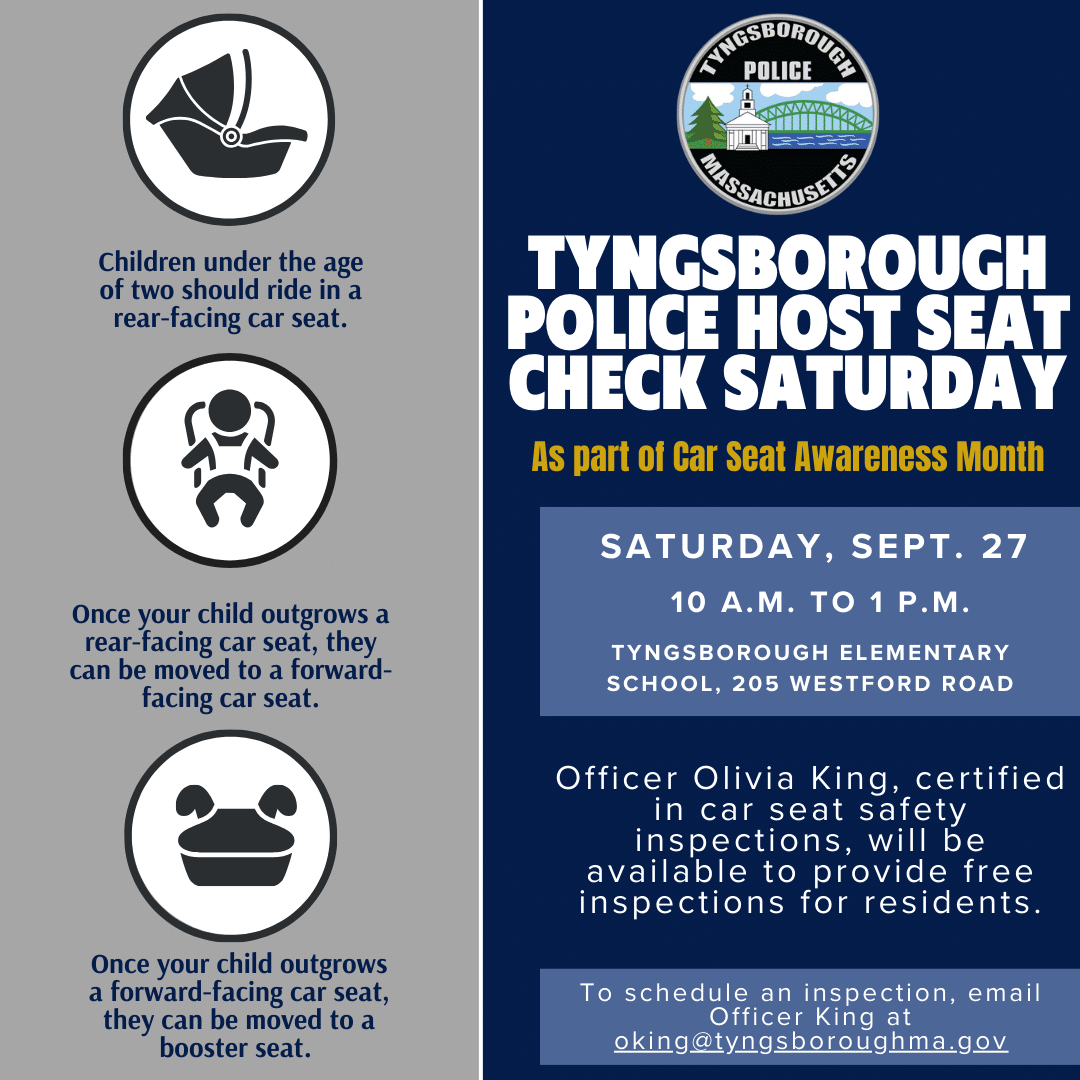
As part of National Child Passenger Safety Month, Tyngsborough Police would like to remind parents and guardians to ensure their children are in the correct size car seat for their age and size, and that they are properly buckled.
This Saturday, Sept. 27, from 10 a.m. to 1 p.m., at Tyngsborough Elementary School, 205 Westford Road, Police will be hosting free car seat inspections for residents. Interested attendees are encouraged to schedule an appointment with Officer Olivia King, who is a certified car seat technician, by emailing her at oking@tyngsboroughma.gov ahead of the event.
Tyngsborough Police would like to share the following car seat safety tips and guidance from the National Highway Traffic Safety Administration (NHTSA):
Choose the Right Car Seat for Your Child
- Children under 2 should always ride in a rear-facing car seat. A rear-facing car seat has a harness, which cradles and moves with your child during a crash to reduce the stress to their fragile neck and spinal cord. It is recommended to keep your child in a rear-facing car seat until age 3, or until they reach the top height and weight allowed by the car seat’s manufacturer.
- Your child can be moved to a forward-facing car seat once they outgrow the rear-facing car seat. Forward-facing car seats have a harness and tether that limits your child’s movement during a crash. Tethers should always be used for forward-facing car seats.
- Once your child outgrows a forward-facing car seat, they can be moved to a booster seat. A booster seat raises and positions the child so the vehicle’s lap-and-shoulder belt fits properly over the stronger points of their body, the hips and across the chest. Keep your child in a booster seat until they are big enough to properly fit in a seat belt.
- For a seat belt to fit properly the lap belt must lie snugly across the upper thighs, not the stomach. The shoulder belt should lie snug across the shoulder and chest and not cross the neck or face. The proper placement of a seat belt restrains the child safely in a crash.
- Your child should not be moved to the next car seat level until they reach the top height or weight limit allowed by the car seat’s manufacturer. In 2019, about 16.6% of children 4 to 7 were prematurely moved to seat belts, when they should have been riding in booster seats.
- Children under 13 should ALWAYS ride in the back seat.
Ensure Your Child is Buckled In Correctly
Choosing the correct car seat, but improperly buckling your child into it can lead to serious injury. These steps will help ensure your child is properly buckled in:
- Carefully read the owner’s manual for your car seat to ensure you are properly buckling your child according to the manufacturer’s instructions.
- Always ensure the seat’s chest clip is buckled and at armpit level. If the clip is unbuckled, too high, or too low, a child can slip out of the straps in a crash and suffer serious injury.
- Always ensure the seat’s straps are snug enough that you cannot pinch the straps between your fingers. If the straps are too loose, a child can slip out of the straps in a crash and suffer serious injury.
- Children who are riding in car seats should wear thin clothing, and keep coats or blankets over the seat’s harnesses. Placing jackets or blankets between your child and the straps can lead to your child slipping out of the straps in a crash.
All 50 states and the District of Columbia have laws requiring children to be secured in appropriate car seats or booster seats based on their age and size.
Additionally, Massachusetts law requires that all children ride in an approved child safety seat until they are at least 8 years old or 57 inches tall.